Budget consultation 2026-27
Final decisions on the 2026-27 budget for Neath Port Talbot were made by the Cabinet on Wednesday 4 March, and a meeting of the full Council on Thursday 5 March 2026.
You can find out more about this year’s budget:
- in this Vlog from our Cabinet Member for Finance, Performance and Social Justice
- read the full budget report
- read more about the budget in general at www.npt.gov.uk/budgetandspending
Overview of 2026-27 budget
The budget for 2026/27 is set to deliver a record level of investment in schools and protect vital front‑line services at a time of continuing financial pressures.
It will support essential day‑to‑day services, from maintaining roads and educating thousands of children to caring for vulnerable people and collecting household waste, while keeping the council tax increase among the lowest in Wales.
There will be an additional £7 million to support pupils with additional learning needs, alongside a further £330,000 for building maintenance, which will include improvements to school facilities.
Other key highlights and additional investments include:
- continuing to deliver key grant‑funded developments that support the local economy, including the building of new schools, the redevelopment of the Princess Royal Theatre to create new event spaces, and the construction of a specialist research facility for the steels and metals industry
- £4.768 million to support adults and children with additional care needs
- £100,000 for playground maintenance, supporting the council’s £2.5 million Playground Improvement Programme announced last year
- £170,000 to improve the management of Aberavon Seafront, including a programme of activities
- maintaining two weekly household waste collections and ensuring that green waste collection remains free of charge
Changes to proposals
The budget proposals included more than 40 savings and income generation ideas. These will not result in significant service or policy changes, so they were not part of the consultation. The following changes have been made to the final budget:
- At the 4 February 2026 Performance and Resources Scrutiny Committee Members requested that the following proposed saving be considered separately by the Visible Services and Streetscene Scrutiny Committee: ‘ENV 13 - Increase bulky household waste charges by £10 (from £29.50 to £39.50 for up to 7 items)’. As a result, the saving proposal remains within the schedule but will not be implemented until the scrutiny committee has met to consider.
- ENV14 - Change of food waste bags from bio-degradable to 100% recycled plastic once current supplies end – £100k. This saving has been withdrawn, additional grant income from Extended Producer Responsibility (EPR) funding can be utilised to offset the shortfall.
- The Welsh Government have confirmed that the Council will receive a one-off grant of £75k towards the pay element increase of Fire Authority levy. As this is a one off grant the core funding required for the Fire Levy has not been reduced. Cabinet will consider proposals for this one off £75k in the new financial year.
NPT Budget Consultation 2026-27 - what you told us…
A public consultation on the draft proposals took place between 15 January and 11 February 2026, with 616 responses received. The consultation asked residents for their views on the proposed council tax increase and how the council could address the budget gap.
Thank you all for your feedback. Here are some of the things you told us…
Council Tax
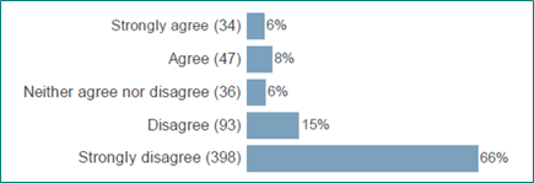
Respondents were asked to what extent they agree or disagree with increasing Council Tax by 3.5% next year to help avoid cuts to services provided by the council. Responses were as follows:
Supportive
Of the 81 respondents (13.3%) who indicated they “agree” or “strongly agree”, 69 (85.2%) gave reasons for their response. The themes included:
- protecting services and avoiding further cuts
- maintaining jobs and supporting the local economy
- increase reasonable
- alignment with inflation and rising costs
- funding essential services has to come from somewhere
- priority for children, education, and vulnerable groups
- expectation of visible improvements and value for money
- acknowledgement of cost-of-living pressures and inequality
- collective responsibility - spreading the cost across residents helps protect services for the wider community
Unsupportive
Of the 491 respondents who indicated they “disagree” or “strongly disagree”, 472 (96.1%) gave reasons for their response. Overall opposition is rooted in affordability, fairness, and trust. Respondents to this question feel they are being asked to pay more during a cost-of-living crisis, while experiencing declining services, limited transparency, and insufficient evidence of value for money. The themes included:
- cost of living pressures and inability to pay
- Council Tax in Neath Port Talbot is already perceived as high
- poor value for money and declining services
- lack of trust in how money is spent
- wages not keeping pace with increases
- perceived unfairness of the council tax system
- disproportionate impact on vulnerable and fixed income groups
- geographic inequality across the borough
- consultation fatigue and lack of confidence in decision making
- calls for alternative approaches
Neither supportive or unsupportive
36 respondents indicated they “neither agree nor disagree” with the proposed council tax increase. Of these 31 (86.1%) gave reasons. Overall, the neutral responses largely reflected reluctant acceptance combined with scepticism. Respondents were not opposed in principle to funding vital services but were unconvinced about efficiency, fairness, visibility of benefits, and the impact of public consultation. Neutrality therefore represents caution, concern, and conditional tolerance rather than disengagement. The themes included:
- conditional acceptance linked to service improvement
- concerns about value for money and efficiency
- cost of living pressures and affordability
- perceived inequality and unfairness
- acceptance that increases are inevitable
- scepticism about consultation and influence
- mixed views on the scale of the increase
Suggestions for reducing the budget gap
Respondents were asked if they have any suggestions on how the council can reduce the budget gap. They were providing a list of services to assist their responses. 467 respondents (75.8%) provided feedback to this question. The themes included:
Efficiency savings (reducing costs / improving how money is spent), including:
- workforce, management, and governance “top-heaviness”
- reduce spend on “non-essential” activity and avoid “vanity projects”
- estate rationalisation/office accommodation
- energy and utilities efficiencyPr
- procurement, contracts, and use of third parties
- operational/service efficiencies (how services are delivered)
- financial control, transparency, and audit – stronger scrutiny of spend
Income generation
- Increasing fees, charges, and service-related income
- Ideas for commercial use of assets and property
- Tourism, events, and place-based revenue
- Securing more grants, external funding, and investment
- Economic growth to broaden the tax base
Other ideas or comments
- Fairness, accountability, and trust
- Use of reserves
- Prioritising core services
- Some criticism of specific officer and political roles and certain programmes/initiatives
- Community involvement/volunteering
Who we heard from
Of those who responded to our ‘about you’ questions:
- 98% (599) of respondents said they were residents of Neath Port Talbot
- 2% (10) were aged under 25; 14%% (83) were aged 65 years or above, and 80% (484) were between 25-64 years
- 54% (326) said they were Female; 37% (224) were Male; 8% (49) preferred not to say
- 21% (127) considered themselves to have a disability
- 27% (159) had caring responsibilities
- 19% (114) were single; 52% (315) married; 7% (42) in a civil partnership; 6% (35) divorced/separated; 4% (21) widowed
- 3% (15) were expecting a baby; 2% (11) had a baby on the last 6 months; 1% (6) was on maternity leave; less than 1% (1) was on paternity leave; 93) were heterosexual/straight; 1% (7)
- 83% (4) were heterosexual/straight; 1% (7) were Gay men; 1% (4) were gay women/lesbians; 1% (4) were bisexual; 1% (6) stated ‘other’
- 88% (522) were white; 1% (5) Mixed/ Multiple ethnic groups (including White and Black Caribbean; 2 indicated White and Welsh; 1 indicated White and Black African; 1 indicated White and Asian); less than 1% were Asian/Asian British or Black/African/Caribbean/Black British. 1% (3) specified ‘other ethnic group’ (including Black Caribbean, German, Polish, Arab)
- 51% (300) had no religion; 36% (213) were Christian (all denominations), less than 1% (1) was Buddhist; less than 1% (1) was Muslim. 2% (12) indicated ‘other religion’ which included Jedi; Buddhist & Wiccan; Pagan; Spiritual; Spiritualist
- 8% (45) said that they or their partner were currently serving or had served in His Majesty’s Armed Forces
- 97% (572) said their main language was English; 2% (12) said Welsh
- 26% (149) could understand spoken Welsh; 14% (80) could speak Welsh; 16% (91) could read Welsh; 10% (56) could write Welsh; 69% (401) could not understand, speak or write Welsh.