Article
Construction underway on SWITCH research centre in Port Talbot
This article is more than 6 months old
17 March 2026
Construction has now begun on the South Wales Industrial Transition from Carbon Hub, otherwise known as SWITCH. It is a £28 million research facility designed to accelerate the decarbonisation of the steel and metals sector. When fully operational, up to 95 staff are expected to be based there.
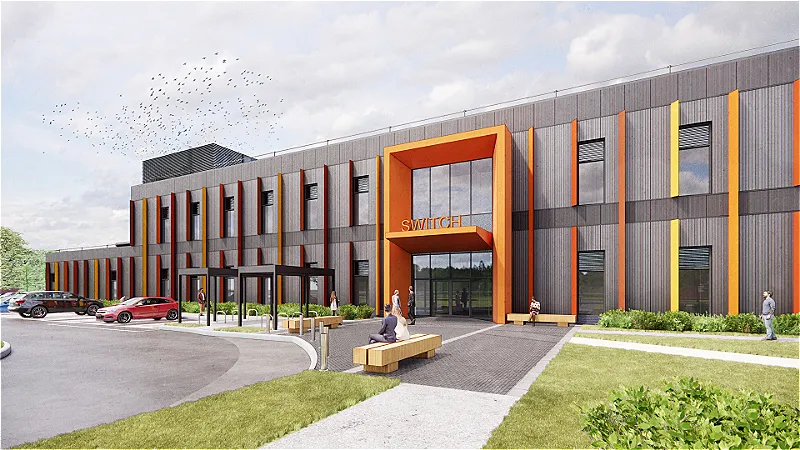
The project, led by Neath Port Talbot Council in partnership with Swansea University, is being delivered by Morgan Sindall Construction, who were appointed to design and build the centre, part of the Swansea Bay City Deal and TATA Transition Fund, on a brownfield site at Port Talbot’s Harbourside.
SWITCH was awarded £8.2m from the Tata Transition Fund provided by UK Government Tata Steel / Port Talbot Transition Board, with £20m being awarded through the Swansea Bay City Deal. The facility is located in the Harbourside area, which has an emerging innovation district, and benefits from excellent transport links via the M4 and Port Talbot Parkway railway station.
The facility, to be known as SWITCH Harbourside, will be a purpose built, open access research hub supporting innovation across academics, industry and government. Its focus will help sectors such as steel and metals with their decarbonisation processes, helping develop circular economy models and create advanced materials for a net zero society.
Inside, the building will include workshop and welding areas, specialist mechanical testing zones, laboratories and a modern office space for the staffing group.
Morgan Sindall Construction, which recently delivered Baglan Energy Park’s award-winning Bay Technology Centre, will incorporate sustainable energy technologies into SWITCH Harbourside’s design.
This includes solar panels to provide clean energy throughout the site and measures to eliminate the use of fossil fuels during construction, supporting the council’s Decarbonisation and Renewable Energy (DARE) strategy.
The project forms part of the wider Swansea Bay City Deal Supporting Innovation and Low Carbon Growth programme and represents a major milestone for the region’s transition to a green economy.
Councillor Jeremy Hurley, Cabinet Member For Climate Change & Economic Growth at Neath Port Talbot Council said:
“We are delighted to see work begin on the SWITCH site, as the Council continues to focus on creating sustainable working environments and delivering new jobs and opportunities for our community.
“We look forward to seeing this innovative development progress, and we thank our partners at Swansea University for their support in bringing this project to fruition. Our thanks also go to Morgan Sindall for their excellent work, and to the UK Government for their continued support.”
Secretary of State for Wales Jo Stevens said:
“The UK Government is investing well over £100 million in Port Talbot to help develop the industries of the future like clean steelmaking, offshore wind power generation and research and development.
“The progress of the SWITCH project is a step forward in these aims as we work to create jobs and growth in the town and right across Wales.”
Cabinet Secretary for Economy, Energy and Planning, Rebecca Evans, added:
“The Swansea Bay City Deal continues to deliver for businesses and residents across the region, with SWITCH Harbourside representing an important step forward in supporting the transition of Wales toward a low‑carbon future.
“This new research centre will provide high quality jobs for the community and strengthen the region’s position in advanced manufacturing and clean energy.
“Bringing industry, academia and government together, the facility will also support the development of new technologies and skills and edge us yet another step closer to our net zero agenda.”
Professor Helen Griffiths Pro-Vice-Chancellor Research and Innovation, Swansea University:
"SWITCH Harbourside is about delivering the practical solutions required for industrial decarbonisation. Our research expertise will help the steel and metals sector develop the new technologies and processes needed to transition to net zero, strengthening the regional supply chain and securing South Wales’ position at the heart of the green economy."